Earlier this century, I believed with all of my being that my heritage was German, Swedish and French, and that my great-grandmother was a Cherokee princess descended from Pocahontas. When my son, who rarely displays an interest in anything besides video games, said he’s like to take a DNA test, I agreed. Always good to encourage the kiddo’s interest, and his father’s Baltic and Native American roots were likely to be much more interesting than mine.
So we all took swabs — Caleb, my parents and I — and waited for the results.
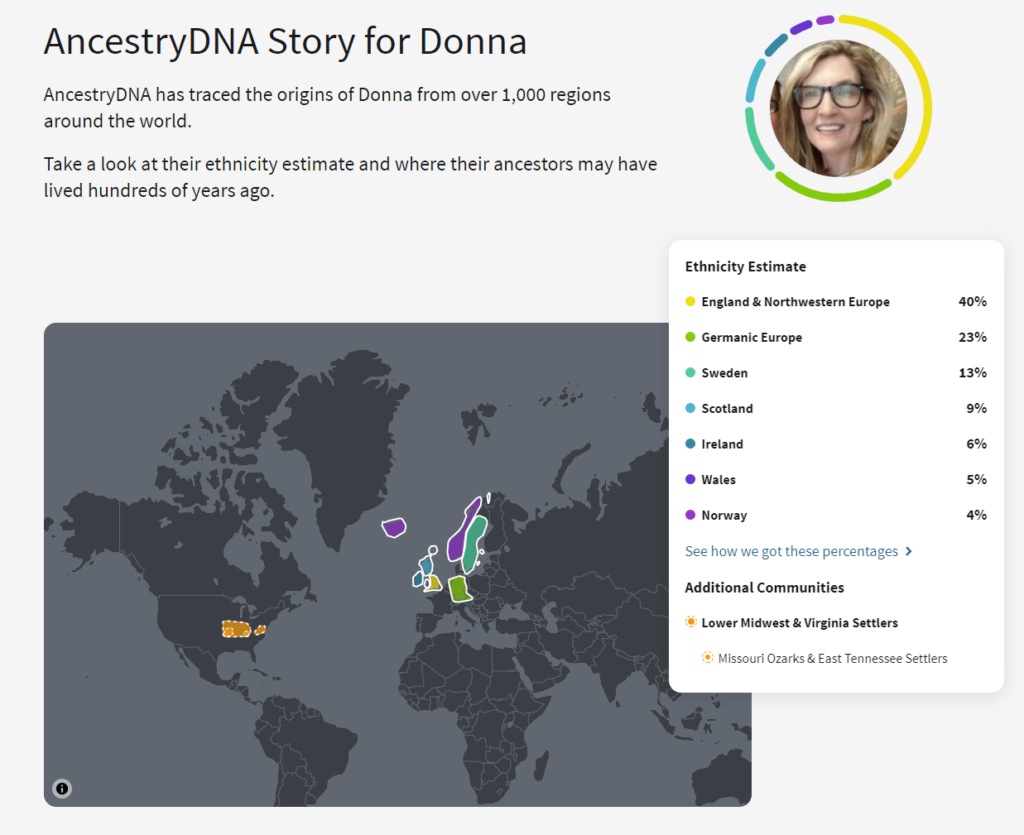
A few weeks later, my beliefs crumbled. I’m British? I’m not Native American? This couldn’t be right! This test must be a joke. (Caleb’s results came back largely as expected, although he didn’t have any Native American in his admixture either.)
Determined to prove that I knew more than a silly blood test, I signed up for a trial of Ancestry.
Three days and 72 sleepless hours later, I had close to a thousand people in my tree. I was descended from Kings and Queens! I am ROYALTY! I hadn’t yet learned about source documentation, and didn’t know that other trees were often inaccurate. I cut and pasted and connected and found out that what I thought I was didn’t matter at all because what I am is REALLY important. My German and Swedish ancestry (which did show up in my admixture) was a “brick walls,” a term I quickly learned and rue to this day.
As it turned out, much of that original research was incorrect, and several years later, I’m still finding my own errors.
But what do you know? I’m western European, mostly British. I really am. My ancestors were early US immigrants. I’d heard my mother speak of theTrigg family, and it quickly showed up in my tree. A US Congressman? A friend of Thomas Jefferson? She never told me that! My maternal grandmother’s family were early Dutch settlers of New York, the Wynkoops (she always told me she had no idea where her family came from). My paternal grandfather’s family was indeed German, immigrated in the mid-1800s, but all records stopped on this side of the pond. Similar with my Swedish great-great-grandfather, whose census records variously claim he came over in 1852 or 1849, and that his name was Johnson or Johansson or Swanson or Svensson. The lesson there — I had believed in the heritage of my most recent immigrants, whose heritage was known. But once the veil was lifted, there was far more British and Irish than I would ever have believed had I not discovered it myself.
As for the Native American, my mother to this day tells people she is descended from Cherokee royalty. When I take a genealogy trip, she asks if I “found the Indian”. And it’s possible — there’s a Penelope in my tree who might have been a Bolling descended from Pocahontas. That branch of the family has a long history of naming their daughters Pocahontas. Family historians have been arguing for at least 100 years “Which Penelope?” married into the family. The hardest lesson in genealogy is to admit there are some mysteries that cannot be solved.
Many years later, genealogy has become my passion. I’ve travelled the US seeking information in dusty courthouses and remote genealogy rooms. I’ve made one the best friends of my life; and, yes, she’s a cousin. It doesn’t matter where I came from, but rather what I came from. I’m a Southerner, and a Quaker, and a compilation of all those who preceded me. I am uniquely me because of them.
And I can still spend three sleepless days at my computer seeking out more information about my family.
.